BEBOND is
A framework grounded in science.
A community built on human presence.
A marketplace for the experiences that truly matter - to our children and to us.
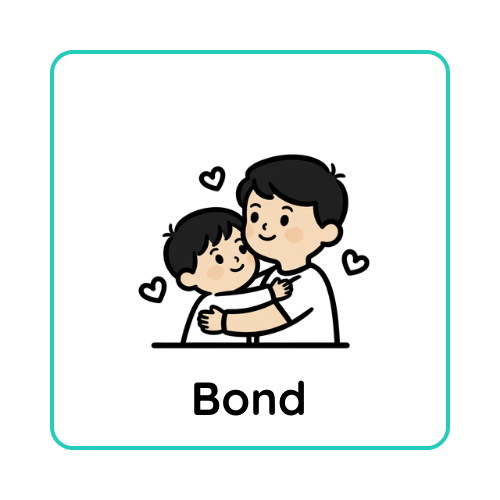
BOND
The Foundation of All Relationships
Bonding activities give us the chance to make sure our children feel seen, heard, valued, and unserstood. In these moments, our children develop emotional security, stronger relationships, and the confidence to explore the world. In responsive, warm interactions – whether reading at bedtime, cooking side-by-side, walking in the forest, or simply being fully present with each other – our children learn they are worthy of love and build the foundation for lifelong emotional health.
These bonds strengthen their friendships, independence, and cognitive growth.
For us as parents, genuine bonding moments aren't just duty – they're restorative. Engaging warmly with our child enhances our own mental health, reduces stress, and improves life satisfaction. Co-regulation during bonding helps us practise emotional attunement while activating the calming parts of our nervous system, benefiting both of us at the same time.
EXPLORE
Curiosity for Life
Exploration fuels our children's natural curiosity, driving cognitive development and learning. When children investigate, ask "why?", and discover new things, they build stronger problem-solving skills, concentration, and confidence.
Research shows curious children demonstrate higher IQ scores and develop better vocabulary and executive function. Exploratory play teaches our children the world is knowable and their questions matter.
For us, parents, exploring alongside our children isn't exhausting - it's actually a cognitive protection. Co-investigating questions together stimulates our brain's reward systems, builds neural reserves that reduce dementia risk, and provides the novelty that decreases stress and boosts wellbeing. Our kids’ endless questions is like a free cognitive training sessions for our own brain.

BUILD
Growing Through Making & Creating
Building and making activities – from LEGO constructions to scrapbooking and bread baking – teach our children essential problem-solving, planning, and persistence skills. Hands-on creation strengthens executive function (the brain’s control centre), mathematical thinking, and spatial reasoning. Children who regularly build and make things develop better emotion regulation, stronger academic skills, and confidence in their own abilities. The embodied experience of physically creating something helps concepts stick better than passive observation.
For us as parents, building and making things together with our children creates the conditions for flow state – that deeply satisfying absorption where time disappears and worries fade. Creative, hands-on activities lower cortisol, reduce anxiety and depression, and provide meditative focus. Building with our children isn’t about adding to our workload – it’s a form of therapeutic stress relief we get to experience together.

OBSERVE
Being Mindfully Present Every Day
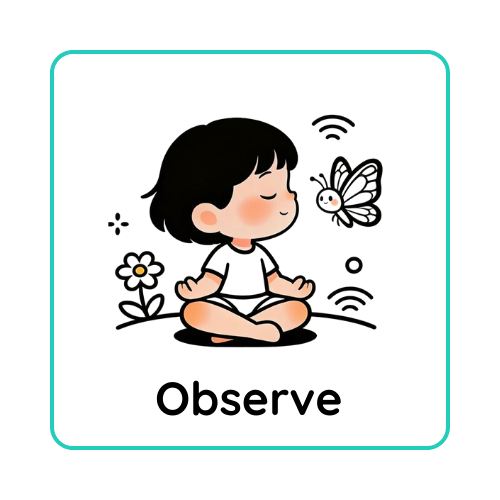
Observation helps our children develop present-moment awareness and reflective thinking. Whether watching ants, noticing a friend's emotions, or reflecting on experiences, observing builds mindfulness and metacognition – thinking about thinking. Children who practise observation show better attention, impulse control, emotional regulation, and reduced anxiety. They learn to pause before reacting and become more effective learners and problem-solvers.
For us as parents, observing mindfully with our child provides measurable mental health benefits. Just 10 minutes of daily mindfulness practice reduces depression and anxiety while improving wellbeing and sleep. When our child invites us to ‘just watch this’ – clouds, puddles, insects – they're offering us spontaneous mindfulness practice proven to calm rumination and stress. Observing together is everyday mental health care, woven into precious shared moments.
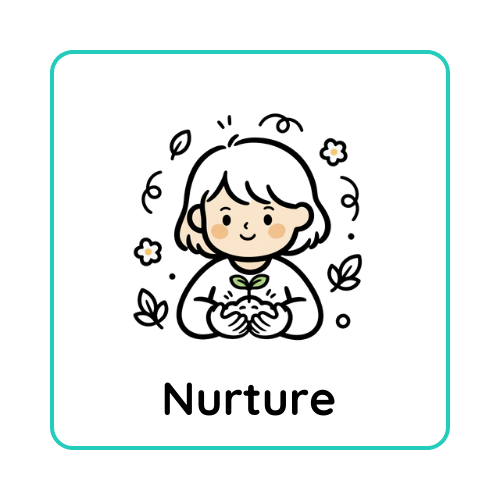
NURTURE
The Key to Resilience and Strength
Nurturing activities teach our children empathy, compassion, and self-kindness – foundations for healthy relationships and resilience. When children care for others (pets, siblings, friends) and learn self-compassion, they develop stronger emotional intelligence, better mental health, and higher-quality friendships. Importantly, self-compassion makes our children more willing to try new things because they know they'll be treated with kindness, even if they fail. Warm, responsive caregiving literally shapes our children's capacity for emotional regulation.
For us as parents, nurturing alongside our child provides profound benefits. Helping others releases dopamine, reduces stress hormones, and increases life satisfaction – volunteers even live longer. Practising compassion and self-kindness significantly reduces our anxiety and depression while improving stress management. Nurturing activities aren't obligations that deplete us – they're evidence-based interventions that actively restore our wellbeing.
DREAM
Imagination is Renewal
Imaginative play helps our children develop creativity, problem-solving, and future-oriented thinking. When children engage in pretend play, storytelling, and "what if?" thinking, they build perspective-taking, empathy, executive function, and language skills. Imagination isn't escapism – it's practising the ability to envision alternatives, essential for innovation and adaptability. Creative play strengthens neural connections, enhances cognitive flexibility, and builds confidence in generating novel ideas.
For us as parents, playing imaginatively with our child is powerful stress medicine. Play and creative hobbies reduce cortisol, enhance mood, improve cognitive flexibility, and buffer against burnout. Engaging in pretend play activates brain regions responsible for creativity and emotional regulation while providing the flow state that deeply restores our wellbeing. When our child invites us into their imaginary world, they're offering us cognitive renewal and emotional restoration – play is the rest we all deserve.

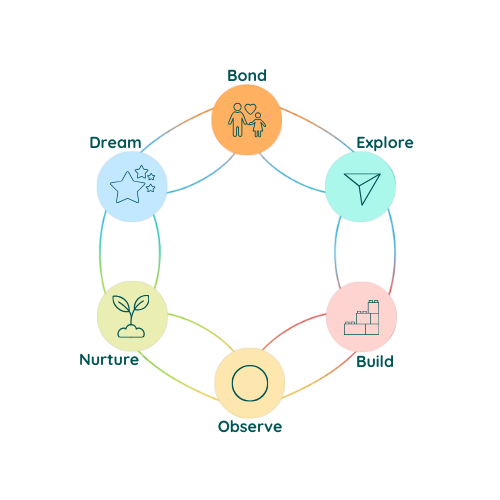
The Holistic Five 🖐️
Because little brains grow through every adventure, every discovery, every sensation and connection they make, balance becomes the key ingredient for confident, creative children. That's why we've researched and curated essential activity types to help you give your child the full spectrum of experiences they need to thrive.